
PRP hair treatment for men is a nonsurgical option for some men experiencing thinning hair, especially early male pattern hair loss. At Skin & Beauty Center in Westlake Village, board-certified dermatologist Dr. Justine Park evaluates the cause of hair thinning and helps patients understand whether platelet-rich plasma (PRP) injections belong in their treatment plan. The before-and-after photographs featured below show a patient with visibly improved coverage at the crown after treatment. Results can be encouraging, but they vary from person to person.
How Does PRP Hair Treatment Work for Men?
PRP stands for platelet-rich plasma. A clinician draws a small amount of the patient’s blood, processes it in a centrifuge to concentrate platelets, and injects the prepared plasma into selected areas of the scalp. Platelets contain signaling proteins, including growth factors, that may support activity around existing hair follicles. The treatment uses material derived from the patient’s own blood, rather than transplanted hair.
Research suggests PRP may improve hair density or thickness in some patients with androgenetic alopecia, commonly called male pattern hair loss. However, protocols differ among clinics and studies, and evidence is not uniform. PRP is not guaranteed to restore a full head of hair or create new follicles in completely bald areas. It is generally considered an adjunctive, rather than universally definitive, therapy.
For more information about the approach, explore Skin & Beauty Center’s hair restoration and skin rejuvenation services.
What Do These Before-and-After PRP Hair Results Show?
This male patient’s before-and-after photographs, supplied for this article as a treatment result from Dr. Park, show the top and crown of the scalp. In the before photograph, more scalp is visible through the thinning hair. In the after photograph, the crown appears to have fuller coverage, with less scalp showing through. It is a compelling visual example of the type of improvement some patients seek with PRP.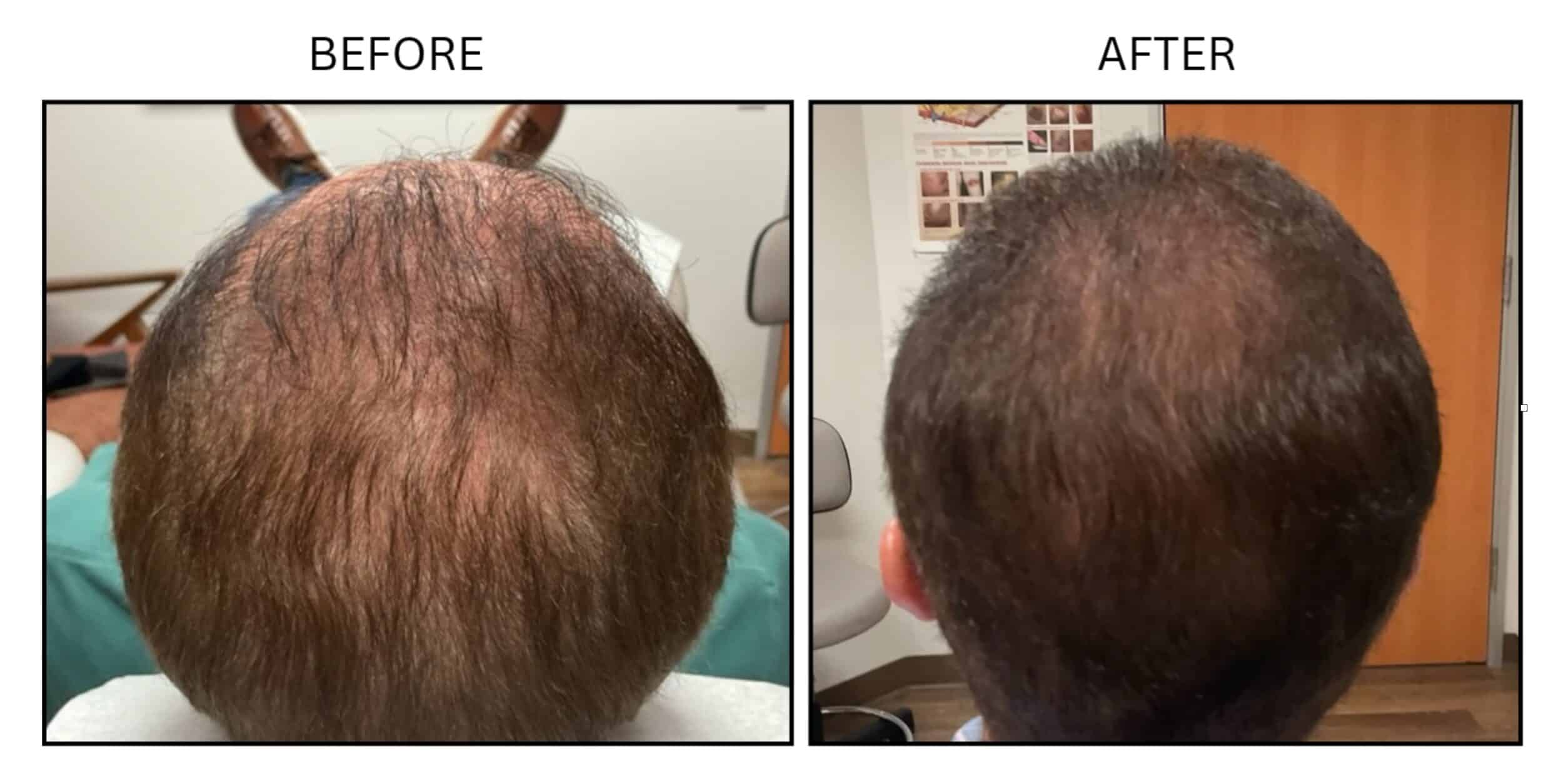
Photographs alone cannot establish the number of treatments, time between images, whether other hair-loss therapies were used, or an objective change in follicle count. Hair length, lighting, styling, and camera angle can also affect appearance. For that reason, Dr. Park considers a patient’s examination, medical history, and progress over time when discussing results, rather than relying on a photograph alone.
Who Is a Good Candidate for PRP Hair Restoration?
Men with early to moderate thinning and still-active hair follicles may be better candidates than men with extensive, long-standing bald areas. Male pattern hair loss often develops gradually at the temples, hairline, or crown, although the pattern varies. PRP may be considered when the goal is to improve the appearance of density or support existing hair, not to replace a surgical hair transplant.
Not every form of hair loss is androgenetic alopecia. Sudden shedding, patchy loss, scalp redness, scaling, pain, or scarring may signal another condition that needs evaluation before cosmetic treatment. Certain blood disorders, active infections, medications, or medical conditions can also affect whether PRP is appropriate. A dermatologist can help identify these issues and discuss safer or more effective alternatives.
Patients concerned about unusual or patchy shedding can also review the practice’s information on alopecia areata and hair loss evaluation as a starting point for discussing symptoms with a dermatologist.
How Many PRP Sessions Does It Take to See Hair Growth?
PRP hair restoration is usually planned as a series rather than a single appointment. Many treatment protocols begin with approximately three or four sessions spaced several weeks apart, followed by periodic maintenance when appropriate. The exact schedule should be individualized based on the diagnosis, response, goals, and the clinician’s protocol.
Hair grows slowly. A patient may notice less shedding or subtle changes before fuller-looking hair becomes apparent, and visible improvements often require several months. Consistent photographs and follow-up visits are more useful than judging results from one week to the next. Because hereditary hair loss can continue progressing, maintenance treatment or other medical therapies may still be needed.
A consultation should clarify the recommended number of visits, expected total cost, how improvement will be assessed, and what would prompt a change in the plan. PRP for hair loss is generally considered an off-label use of platelet-rich plasma procedures and is commonly not covered by insurance.
Is PRP Better Than Minoxidil, Finasteride, or a Hair Transplant?
PRP is not automatically better than established treatments. Topical minoxidil and prescription finasteride have substantial evidence for male pattern hair loss, although they have different risks, benefits, and suitability considerations. Some men use PRP alongside one of these options under medical guidance. Combining therapies may be reasonable, but the best plan depends on the diagnosis and individual circumstances.
Hair transplantation moves follicles from one area of the scalp to another and may be considered for more advanced or stable hair loss. PRP does not redistribute follicles and should not be described as a replacement for transplantation. Men who prefer a nonsurgical option may find PRP appealing, especially when they still have substantial hair in the thinning area.
Dr. Park can help patients weigh treatment goals, tolerance for injections, long-term maintenance, and the possibility of modest or limited improvement. A good decision is based on realistic outcomes, not simply the most dramatic before-and-after image.
What Happens During a PRP Scalp Treatment, and Is There Downtime?
An appointment typically begins with a blood draw. After the blood is processed, the clinician administers multiple small injections across targeted areas of the scalp. Some patients experience temporary discomfort, pressure, or tenderness. The appointment length varies, but many sessions can be completed within about an hour.
Mild swelling, redness, pinpoint bleeding, headache, or scalp soreness may occur afterward. Bruising or infection is possible, though less common. Your clinician will explain specific aftercare instructions, including when to resume washing your hair, exercise, or scalp products. Tell the practice about medications, bleeding concerns, and medical conditions before treatment; do not stop prescribed medications without medical advice.
Because the procedure is minimally invasive, many patients return to their normal routines quickly. Nonetheless, PRP is a medical procedure and should be performed with appropriate sterile technique and clinical oversight.
Where Can Men Ask About PRP Hair Treatment in Westlake Village, CA?
Men noticing crown thinning, a widening part, or a receding hairline can begin with an individualized assessment at Skin & Beauty Center in Westlake Village. Dr. Justine Park is a board-certified dermatologist who offers a patient-centered approach to cosmetic and medical dermatology. During a visit, the priority is to identify the type of hair loss, discuss realistic outcomes, and determine whether PRP or another treatment strategy makes sense.
The Westlake Village office is located at 696 Hampshire Road, Suite 110, Westlake Village, CA 91361. Ask the office to confirm current PRP hair restoration availability at this location when scheduling, since online service listings can differ by office.
Book a hair loss consultation at our Westlake Village location or call (805) 725-6414 to discuss an appointment with Dr. Park.
What Should You Ask Before Starting PRP for Hair Loss?
A useful consultation includes a clear diagnosis, an explanation of why PRP may or may not help, and a realistic timeline. Ask how many sessions are recommended, whether additional treatments such as minoxidil or finasteride should be considered, and how results will be tracked. It is also reasonable to ask about discomfort, side effects, cost, maintenance, and what to do if the first treatment series produces little improvement.
The most useful goal is not necessarily to recreate a younger hairline. For many men, slowing visible thinning or improving coverage at the crown can be a meaningful result. The patient images in this article illustrate one encouraging outcome, but an examination is the best way to determine what is achievable for your own hair.
________________________________________
Written by Dr. Justine Park, MD, Board-Certified Dermatologist, Skin & Beauty Center, Westlake Village. Published October 2026.
