
If you have been searching for how to get rid of spider veins on your legs, you are not alone. Millions of people develop the red, purple, or blue web-like clusters that spread across the thighs, calves, and ankles, and the question of what to do about them is one of the most common concerns dermatologists hear. The good news is that sclerotherapy has been used for decades to eliminate these vessels safely and effectively, with most patients seeing significant clearing after just two to three sessions.
Watch the treatment in action below, then keep reading to understand exactly what sclerotherapy involves, who it helps, and what real results look like.
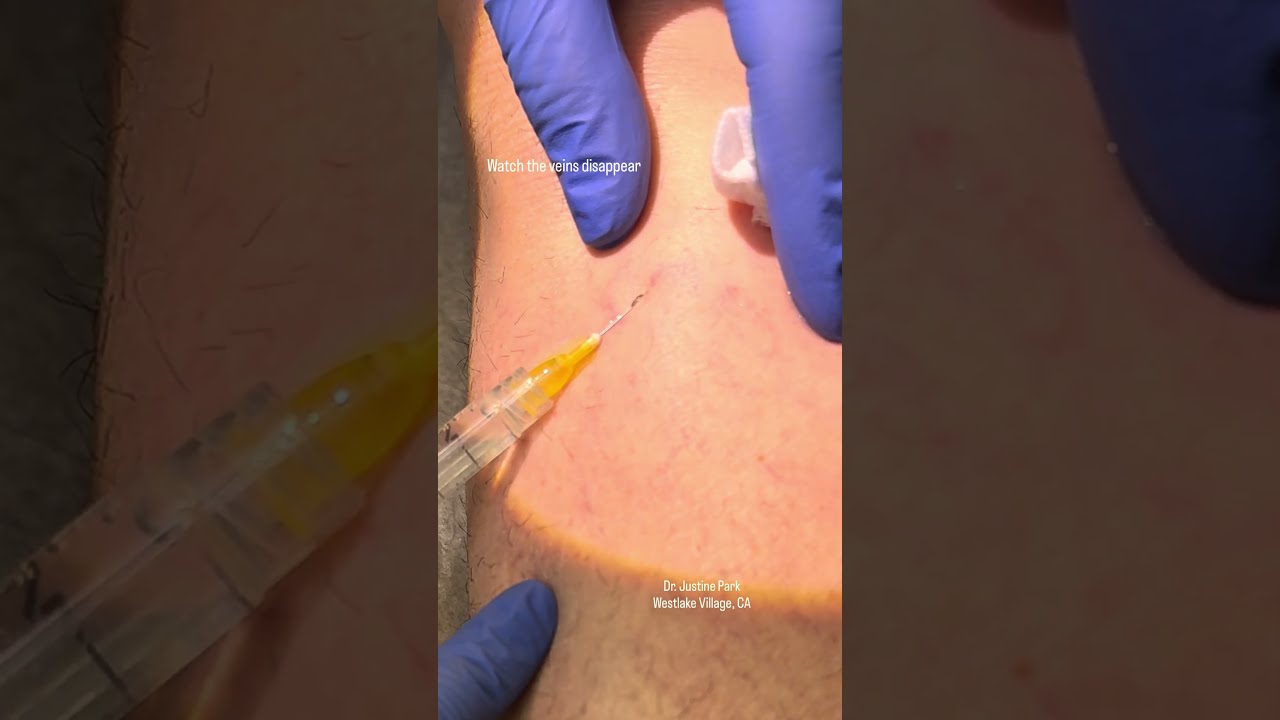
Sclerotherapy treatment performed by Dr. Justine Park at Skin and Beauty Center, Westlake Village. A fine needle is used to inject a sclerosing solution directly into the affected vein.

Before and after sclerotherapy at Skin and Beauty Center. Left: spider and varicose veins visible across the lower leg. Right: same patient after treatment, showing dramatically clearer, smoother skin.
What Are Spider Veins and Why Do They Appear?
Spider veins are small, damaged blood vessels that become visible just beneath the skin's surface. Unlike varicose veins, which are raised and rope-like, spider veins lie flat and radiate outward in a fan or web pattern. They can appear almost anywhere on the body, but the legs are the most common site because of the increased pressure from standing and walking throughout the day.
Several factors increase the likelihood of developing them:
- A family history of spider or varicose veins
- Prolonged periods of sitting or standing, common in office workers, nurses, and teachers
- Pregnancy and hormonal changes, which weaken vein walls
- Sun exposure, especially on the face and upper legs
- Increased body weight, which places extra pressure on leg veins
- Age, as vein walls naturally lose elasticity over time
Spider veins are not usually dangerous, but they can cause aching, itching, or a heavy feeling in the legs by the end of the day. Many patients seek treatment primarily for cosmetic reasons.
What Is Sclerotherapy and How Does It Work?
Sclerotherapy is a minimally invasive injection procedure specifically designed to collapse unwanted leg veins. During the treatment, your provider injects FDA-approved sclerosing solution, Asclera (polidocanol), directly into each target vein using a very fine needle. The solution irritates the inner wall of the vessel, causing it to swell shut and stick together. Over the following weeks, your body naturally absorbs the collapsed vein and reroutes circulation through healthier vessels nearby. You can read the full details of how the procedure is performed on our vein treatments service page.
The entire in-office appointment typically takes 30 to 45 minutes. Patients lie down, elevate the leg being treated, and the injections are made in a series of small punctures along each vein. Most people describe the sensation as a mild pinching or stinging, and any discomfort resolves within seconds. There is no general anesthesia, no incisions, and no hospital stay.
Patients who benefit most from sclerotherapy include those with:
- Spider veins smaller than 1 mm in diameter
- Uncomplicated reticular veins between 1 mm and 3 mm in diameter
- Veins that cause itching, discomfort, or self-consciousness
- Veins that have not responded to compression stockings
How Many Sclerotherapy Sessions Will I Need?
This is one of the first questions patients ask, and the honest answer depends on the number of veins being treated and how your body responds to the sclerosing agent. Most patients require two to three sessions, spaced six to eight weeks apart, to achieve optimal clearing. Larger networks of veins or treatment across both legs may require additional appointments.
It is important to understand that results are not immediate. The treated vein will gradually fade over several weeks as your body reabsorbs the collapsed vessel. Some patients notice 50 to 80 percent improvement after the first session, with continued fading over the following months. A small percentage of treated veins, particularly stubborn clusters, may need a touch-up session.
At your initial consultation, your dermatologist will assess the extent of your veins, discuss your goals, and give you a realistic timeline for results. If you also have larger varicose veins, you should see a vascular surgeon to have those evaluated and treated before considering treatment for spider veins.
What Should I Expect After Sclerotherapy Treatment?
Recovery after sclerotherapy is straightforward, and most patients return to normal daily activities the same day. There are a few aftercare guidelines to follow in the days immediately after treatment:
- Wear compression stockings or bandages as directed, typically for two to three weeks after the procedure
- Walk for at least 30 minutes the day of treatment to encourage healthy circulation
- Avoid prolonged sitting or standing for the first 48 hours
- Stay out of direct sunlight on the treated areas for two weeks
- Avoid strenuous exercise, hot baths, saunas, and swimming for three to five days
In the first few days, it is normal to see some bruising, redness, or mild swelling at the injection sites. Small, raised areas called wheals may also appear briefly after the injections, similar to an insect bite, and these typically resolve within a day. Occasionally patients notice temporary brownish discoloration along a treated vein, which fades over weeks to months as the body continues to absorb the vessel.
Matting, a network of very fine new vessels that can appear near treated areas, occurs in a small percentage of cases. This resolves on its own or can be addressed with a follow-up session.
Is Sclerotherapy Better Than Laser Treatment for Spider Veins?
This is one of the most common comparisons patients research before deciding on treatment. The short answer is that both work well, but for slightly different situations, and many patients benefit from both.
Sclerotherapy remains the gold standard for spider veins and reticular veins on the legs. It reaches veins beneath the surface of the skin that a laser beam cannot reliably penetrate at the same depth. The injection delivery allows treatment of multiple vessels in a single session, and clinical studies consistently show success rates between 75 and 90 percent. For veins on the legs, most board-certified dermatologists, including our team at the Skin and Beauty Center Westlake Village location, recommend sclerotherapy as the first-line treatment.
Laser treatments such as Vasculaze are excellent for facial veins, small surface capillaries, and patients who prefer a needle-free option. Laser is also used for very tiny vessels that may be too small to inject precisely. For larger varicose veins, surgical or radiofrequency ablation with a vascular surgeon are more appropriate.
Your dermatologist will evaluate your specific vessels and recommend the right approach or a combination of both during your consultation.
Sclerotherapy at Skin and Beauty Center Westlake Village, CA
Patients in Westlake Village, Thousand Oaks, Agoura Hills, Calabasas, and the surrounding Conejo Valley can access expert sclerotherapy care at our Westlake Village location. Our board-certified dermatologists perform sclerotherapy using Asclera (polidocanol), the FDA-approved sclerosing agent with a well-established safety profile. Every treatment begins with a one-on-one consultation to review your medical history, assess which veins are appropriate for injection, and set clear expectations for how many sessions you are likely to need.
Westlake Village patients appreciate that treatment fits easily into a lunch break or an afternoon off. The in-office procedure takes under an hour, compression stockings are provided, and you drive yourself home. Within weeks, the veins that have bothered you through years of avoiding shorts, skirts, and swimwear begin to fade, and with each successive session, your legs clear further.
Ready to see what your legs can look like?
Book a sclerotherapy consultation at our Westlake Village location or call (805) 725-6414. Our team is here to answer your questions and help you get started.
Frequently Asked Questions About Sclerotherapy
Does sclerotherapy permanently remove spider veins?
The veins that are treated are permanently closed and will not return. However, sclerotherapy does not prevent new spider veins from developing. Factors such as genetics, hormonal changes, and lifestyle continue to influence whether new vessels form over time. Many patients schedule periodic maintenance sessions every year or two to address any new veins that appear.
Can I get sclerotherapy while pregnant or nursing?
No. Sclerotherapy is not recommended during pregnancy or while breastfeeding. The good news is that many spider veins that develop during pregnancy resolve on their own after delivery, so your dermatologist may suggest waiting a few months postpartum before evaluating which vessels remain.
What if my veins are too large for sclerotherapy?
Sclerotherapy is most effective for veins up to 3 mm in diameter. If you have larger varicose veins, your dermatologist will discuss alternative options during your consultation. In some cases, a combination approach using sclerotherapy alongside laser vein treatment or a referral to a vascular surgeon may be appropriate.
How much does sclerotherapy cost?
Because sclerotherapy is most often performed for cosmetic reasons, it is typically not covered by insurance. The cost varies based on the number of veins treated and the number of sessions required. Your provider will give you a complete cost estimate after your consultation, once they have assessed the extent of treatment needed.
Written by Dr. Justine Park, MD, Board-Certified Dermatologist, Skin and Beauty Center, Westlake Village. Published June 2026.
